Propeller Design from Commercial Shipbuilding
According to conventional wisdom, there are three main characteristics of efficient propellers:
- Large diameter
- High pitch
- Low rotational speed
In other words, motors with high torque can work efficient propellers, motors with low torque can't. This is where our high-torque motors can make the most of their advantages and drive efficient propellers very effectively.
But it is not just maximum torque that enables a motor to drive efficient propellers. There should be as few differences as possible between the highest and lowest points on a motor's torque curve in order to be able to operate efficient propellers. The greater the differences are on the torque curve, the closer the design of the propeller must follow the weakest point – with the consequence that an inefficient propeller must also be driven in the high-torque range. Since electric drives have an advantage over combustion motors in this respect, they can work with more efficient propeller concepts. This is particularly true for Torqeedo drives optimised for overall efficiency.
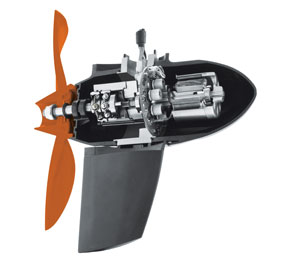
But conventional propeller optimisation is not everything. Many propellers for petrol outboards, especially in the low-power categories, share a very similar form. Torqeedo propellers look very different because they are calculated using the same methods (and, incidentally, by the same experts) that equip advanced commercial ships and submarines with optimised propeller technology. All propeller parameters – diameter, chord length, pitch, skew, rake, camber and thickness – are calculated using multidimensional propeller optimisation calculation methods. Many thousands of iterations are needed for each propeller segment.